THE ULTIMATE GUIDE TO APPLYING TO MEDICAL SCHOOL (2026 EDITION)
Note: This isn’t a step-by-step ‘how to get into medical school’ manual, but a comprehensive list of requirements necessary to apply. Will continue to update as new updates arise!
Note: While this guide is primarily written for students, it can also help mentors better support those they advise. And if this isn’t directly relevant to you but might help someone you know, please consider sharing or restacking. Thank you for helping this reach the people who need it!
Applying to medical school can feel like assembling a puzzle without seeing the picture on the box. When I started this journey, I thought there was a single “right” pre-med formula, the perfect major, perfect scores, perfect timing. Over time, I learned something else: There are many paths to medicine. The most successful ones are often the most authentic.
This guide is everything I wish someone had explained to me clearly, not just what to do, but how to think about the process.
One important note: The specific calendar dates (like “May 5” vs “May 1”) and the exact list of schools requiring CASPer/PREview do change year to year and should always be verified directly with AMCAS/AACOMAS/TMDSAS and each medical school before publication. Costs may also vary, so please check when your cycle opens.
Let’s get started!
1) College
Does Your Major Matter?
No, you do not have to major in STEM.
Medical schools accept students from humanities, arts, social sciences, and beyond as long as you:
✔ Complete prerequisite coursework ✔ Show academic rigor ✔ Demonstrate you can handle science-heavy material
I remember worrying that not taking the “perfect” route would hurt me. But some of the strongest applicants I met were philosophy majors, artists, and community organizers. Medicine needs different thinkers.
Your major is less important than your performance and preparation.
Mathematics/Statistics: 1-2 courses (statistics is highly recommended, calculus may be required by some schools)
Social Sciences: 1 year (introductory psychology and sociology, often required for the MCAT)
⚠️ Quarter vs. Semester Systems
Schools on a semester system usually require two full semesters of a course.
If you’re on a quarter system (common in CA schools like UCLA, UCSD, UCSF), a quarter course is typically 10 weeks, and 3 quarter courses ≈ 2 semester courses.
Medical schools look at both your cumulative GPA and BCPM (Biology, Chemistry, Physics, Math) GPA, sometimes called “science GPA.” Knowing how to classify courses is key.
Psychology or Sociology only if heavily science-based (lab or research-focused, not just lecture on theory)
Advanced quantitative courses (Stats, Calculus, sometimes Computer Science)
Non-Science / Humanities Courses
Arts, literature, philosophy, history
Psychology or Sociology courses that are theory-focused, clinical, or social/behavioral without heavy science content
📌 What AMCAS officially says
1. Classify courses based on primary content When you enter coursework, you must assign each course a classification based strictly on its primary content (e.g., biology, chemistry, math). AMCAS provides a Course Classification Guide with examples of how courses are typically categorized, and you choose the one that best describes what the course was actually about.
2. Content, not department, determines classification AMCAS explicitly states:
So if a class is advanced neuroscience, physiology, or biological statistics with scientific content, you can reasonably classify it in the appropriate science category even if it’s listed under a psych or other department.
3. AMCAS reserves the right to change your classifications During verification, AMCAS may reclassify courses if they disagree with your selection, and you can submit an Academic Change Request if you believe your choice was correct.
💡 Tip from my own experience: I was a Psychobiology major, and some courses had “Psych” in the title but were 80–90% science content (e.g., neuroscience, research methods). AMCAS allowed me to classify these as science courses, which counted toward my BCPM GPA. Always check the course syllabus and consult AMCAS’s course classification guidelines if unsure.
GPA Types on Applications
Cumulative GPA: All courses included, science and non-science.
BCPM / Science GPA: Only science-heavy courses that AMCAS recognizes.
Institutional GPA: Your college transcript GPA; may differ slightly from AMCAS calculations due to repeats or grade adjustments.
✅ Action Step:
Make a spreadsheet with each course, lab or lecture percentage, and how you think it should count.
Check AMCAS’s official guidelines before submitting to avoid reclassification later.
For borderline cases, add a note in your AMCAS coursework comments if necessary.
Required for: Nearly all MD programs and most DO programs.
Registration usually opens in October and remains open thereafter. Applicants with approved accommodations often gain access earlier in the same month.
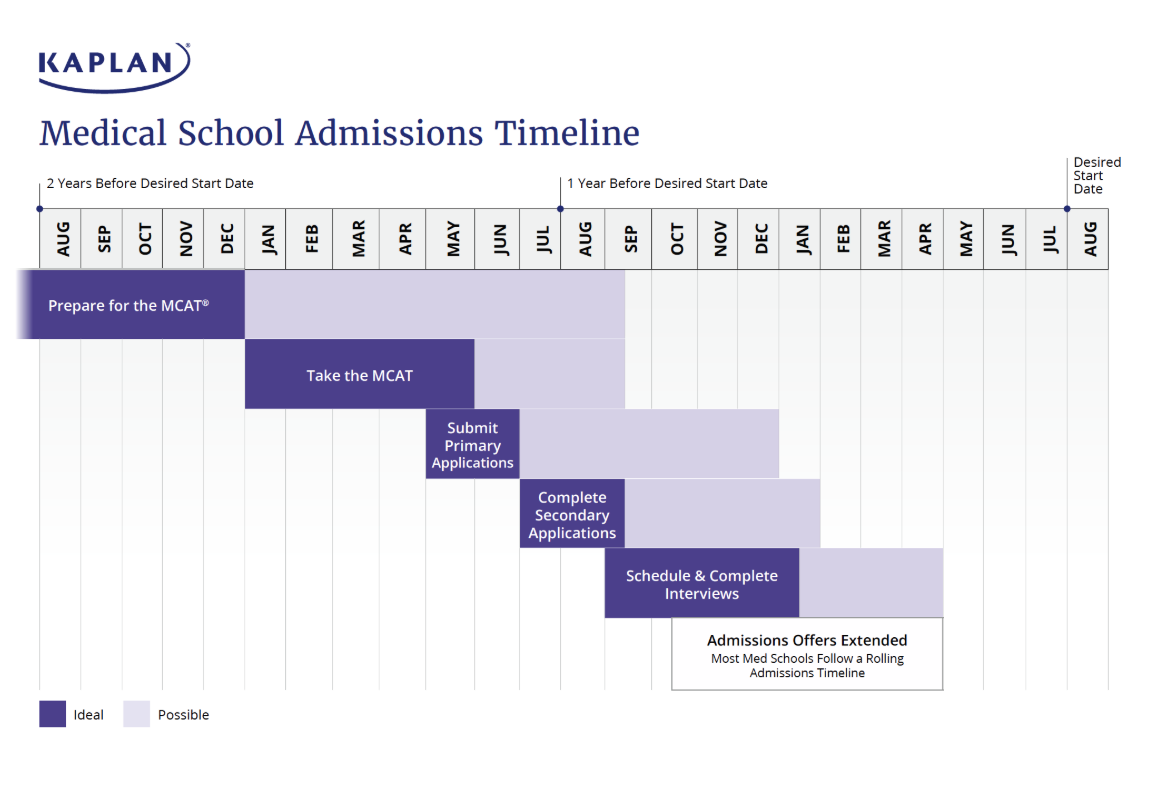
Recommended timing: Ideally, March–May of the year you submit your medical school application. This allows your score to be reported before the application opens in late May.
Score reporting: Expect a ~30-day (1 month) wait for official scores after taking the exam. Plan accordingly if you may retake or void your test.
Retakes & voiding: Both are common. Many applicants take the MCAT more than once. Voiding is an option if you feel your test did not reflect your abilities.
Registration Fees (test only):
Standard registration fee: ~$335 USD to register for the MCAT.
Fee Assistance Program (FAP): Reduced registration (~$145 USD) for students who qualify, plus access to free official prep materials.
International testing: If you test outside the U.S./Canada, there’s an additional ~$130–$120 international surcharge.
Note: There are also rescheduling fees!
Practical Advice:
The MCAT is mentally and emotionally demanding; it’s normal to feel intimidated by early practice exams. Your first practice score does not define you.
The “right time” to take it is when you feel academically prepared and mentally ready.
Track progress, not perfection: improvement across practice tests is more important than a single high or low score.
Example: I took my MCAT in April 2025, which allowed me to receive scores by early May—well ahead of the late May AMCAS application opening.
Tip: Build a realistic study schedule with full-length practice tests under timed conditions. Focus on weaknesses early, but don’t burn out. Balance is key.
What’s On the MCAT?
The MCAT is a full‑day, computer‑based, multiple‑choice exam (~7–7.5 hours total, including breaks). You can receive accommodations for the test; however, which often splits testing into two days instead of one.
It tests knowledge and reasoning skills across four major sections:
Biological and Biochemical Foundations of Living Systems
Intro bio & biochemistry concepts
Chemical and Physical Foundations of Biological Systems
General & organic chemistry + physics concepts
Psychological, Social, and Biological Foundations of Behavior
Reading comprehension and reasoning (no science content required)
👉 Each section mixes content knowledge with scientific inquiry and reasoning skills, so you’re not just memorizing facts, you’re interpreting passages, solving problems, and applying concepts.
Scoring:
Four section scores (each 118–132)
Total score range: ~472–528
What to use to study:
Uworld
Blueprint FLs
AAMC Test Bank/AAMC Practice FLs
Jack Westin (free dupe for Uworld)
Situational Judgment Tests (SJTs)
Some medical schools use SJTs to evaluate non-academic qualities that grades and MCAT scores don’t capture, such as:
Ethics and integrity
Professionalism and teamwork
Empathy and communication
Decision-making under pressure
Not all schools require them, so always verify via MSAR and each school’s admissions site before registering.
Format: Online, timed test with video and written scenarios; you type how you would respond in real-life situations.
Cost: ~$85 for distribution to several schools (additional schools are extra ~$10–20 each).
Timing: Responses must be completed in ~5 minutes per scenario; results sent to schools in 2–3 weeks, and you see a quartile ranking later.
Tip: Take early in the application cycle to avoid delays in your AMCAS/AACOMAS file.
Registration and test dates: Casper test dates are offered monthly, starting in the spring of your application year (often March/April) and running through late summer/fall. Examples from recent cycles show dates from March through December.
Purpose: Short values-alignment assessment comparing your priorities with a school’s mission and culture.
Length: ~15–20 minutes.
Cost: Included with CASPer.
Scores: Sent directly to schools, often within a day.
Duet doesn’t have its own “open date”, it becomes available in your Acuity Insights account after you reserve a Casper test date AND add a program that requires Duet.
Format: Online SJT with multiple-choice scenarios focused on professional readiness and ethics.
Cost: ~$100 (fee assistance available for qualifying students).
Score reporting: ~1 month to both schools and you.
Tip:Schedule early because score turnaround is slower than CASPer.
Registration opens: For the upcoming cycle, registration usually opens on or shortly before March 1 of your application year.
Key Takeaways
These tests measure how you think and respond in professional scenarios.
Plan ahead: Register early to prevent your application from being marked incomplete.
Know the requirements: Each school decides which SJT(s) it accepts; MSAR and school websites are the best references.
3) LETTERS OF RECOMMENDATION (LORs)
Who Should Write Them
Traditional guidance often suggests a mix:
2 science professors (biology, chemistry, physics, or biochemistry)
1 non-science professor (writing, sociology, psychology, or other humanities/social sciences)
1 physician or clinical supervisor (MD, DO, or equivalent)
1 extracurricular mentor (research PI, volunteer supervisor, or leadership mentor)
The real rule: 👉 Ask people who know you well and can speak concretely about your abilities, growth, and character.
Focus on stories and examples, not just adjectives.
Titles don’t matter as much as experience with you—someone who has seen your work ethic, interactions with patients, and initiative will write a stronger letter.
School-specific limits:
Some schools allow only 3–4 LORs, even if you have more.
Check MSAR and each school’s admissions site for exact requirements.
You can select up to 3 experiences as “most meaningful.”
These get an extra 1,325 characters, in addition to the standard 700 characters.
Focus on:
Impact: What effect did your work have on others, the community, or yourself?
Growth: What did you learn? How did it shape your skills or perspective?
Reflection: Why was this experience meaningful?
Example Approach:
Instead of: “I volunteered at a clinic.”
Try: “I helped a Spanish-speaking patient navigate their discharge instructions, earning their trust and improving their understanding of their care plan. This experience strengthened my communication skills and reinforced my commitment to health equity.”
Tips for Strong Entries:
Use specific stories and anecdotes; admissions committees remember experiences that feel personal.
Include numbers or context where possible (e.g., “educated 25 patients,” “organized 3 workshops”).
Vary your categories to show you are well-rounded, but prioritize quality over quantity.
6) TRANSCRIPTS
Getting your transcripts right is critical. Your AMCAS/AACOMAS/TMDSAS application cannot be verified without them, which delays your entire application and interview process.
Step-by-Step Process
1️⃣ List Every School Attended
Include all colleges, universities, community colleges, and post-baccalaureate programs.
Even if you took only one course at a school, it must be reported.
In AMCAS, this is under “Schools Attended.”
2️⃣ Download & Complete Transcript Request Forms
Each school requires a unique AMCAS Transcript Request Form (includes your AAMC ID).
Most schools have forms online via their Registrar or Transcript Office website.
Tip: Ensure your AAMC ID is correct and visible; AMCAS uses this to match transcripts to your application.
3️⃣ Send to Registrar
Submit the official form and request to the school’s registrar.
Specify “Send directly to AMCAS”.
Electronic transcripts are faster; mailed copies take longer.
Some schools charge a small fee per transcript; plan ahead.
4️⃣ Monitor Status
AMCAS shows each transcript as:
Not Received – AMCAS hasn’t gotten it yet
Received – AMCAS has received the transcript, but hasn’t processed it
Processed – Coursework is verified and ready for application review
5️⃣ Enter Coursework Manually
Enter all classes you’ve taken, including:
Grades
Repeats or withdrawals
AP/IB/transfer credits
Double-check course titles, term, credit hours, and grades—errors delay verification.
⚠️ Pro Tips
Start early: Request transcripts months before submission, especially for schools that mail physical copies.
Check for completeness: Make sure each transcript includes all grades and courses.
Track confirmation: Follow up with registrars if a transcript hasn’t arrived in 2–3 weeks.
Avoid last-minute rush: Missing or delayed transcripts are the #1 reason applications aren’t verified on time.
Keep copies for yourself: Scan or save unofficial transcripts for your records.
7) FEE ASSISTANCE
Medical school applications and exams can be expensive, but fee assistance programs help eligible applicants reduce costs for key components.
Private foundations: Search for local or national scholarships aimed at underrepresented students in medicine.
Tips:
Even small scholarships help offset MCAT, application, or interview travel costs.
Keep a list of deadlines; many have early spring deadlines before the application cycle opens.
4️⃣ Independent Status Notes (just to reiterate)
For FAP, AMCAS, and other financial aid, “independent” status is usually only claimed if you meet specific criteria:
Age 26 or older OR
Married, self-supporting, in the armed forces, or legally emancipated.
If under 26 and living with parents, your parents’ income is considered for fee assistance eligibility.
✅ Bottom line:
Apply for AAMC FAP first, then check DO waivers, school-specific scholarships, and professional orgs.
If you’re under 26, plan as a dependent unless you meet other criteria for independence.
Early planning maximizes your financial support and reduces stress.
8) BUILDING YOUR SCHOOL LIST
When creating your medical school list, it’s important to balance strategy, fit, and mission alignment.
1️⃣ Traditional Approach
Reach schools: Where your stats (GPA, MCAT) are below the school’s average — high-risk, high-reward.
Target schools: Your stats are around the school’s average — realistic but still selective.
Safety schools: Your stats are above the school’s average — likely to receive an interview.
This framework helps diversify your application and manage risk.
2️⃣ Mission-Driven Approach (My Personal Approach)
Instead of only looking at GPA/MCAT, I built my list around mission alignment and values:
Community care: Schools emphasizing service and outreach.
Underserved populations: Programs that prioritize working with medically marginalized groups.
California roots: In-state schools with strong local ties and public health initiatives.
I personally also sought out P/F (pass/fail) schools!
Some schools were “reach” based on stats, but I applied anyway because my goals aligned with their mission. Fit and story can outweigh raw numbers. Admissions committees want applicants who share their values.
3️⃣ In-State vs Out-of-State Bias
Public schools often give preference to in-state applicants, so your residency matters when planning reach/target schools.
Strategy tips:
Apply to your state public schools first.
Consider out-of-state schools where your mission, background, or unique experiences align with the program.
For private schools, your residency is usually less important; mission fit and holistic factors carry more weight.
📌 Bottom Line
Build a balanced list of reach, target, and safety schools while prioritizing fit.
Look beyond numbers → mission alignment, values, and personal story matter just as much as GPA and MCAT.
Factor residency for public schools to maximize interview chances.
9) PERSONAL STATEMENT
Goal: Your personal statement should convey why you want to be a physician and who you are, using storytelling and reflection rather than just listing achievements.
Focus on:
Why physician: Specific motivation, not comparisons to other healthcare careers (PA, NP, etc.)
Storytelling: Concrete examples, anecdotes, and patient or mentor interactions
Reflection: What you learned, how you grew, and how it shaped your future goals
Show, don’t tell: Demonstrate qualities like empathy, resilience, curiosity through stories, not adjectives
Suggested Structure
Hook: Start with a compelling moment that draws the reader in.
Three defining experiences: Highlight experiences that illustrate your motivation, values, and growth.
Tie-back conclusion: Circle back to your opening story or central theme and explain how these experiences make you a future physician.
Example: Rather than stating “I am compassionate,” show a story, for instance, where you navigated a patient’s language barrier or helped a family understand a complex health decision.
Getting Feedback
Strong feedback is key to refining your statement. Consider:
Advisors or pre-health consultants – help with structure and clarity
Quality matters more than obsessing over every word.
Admissions committees read hundreds—clarity, authenticity, and reflection stand out.
4️⃣ Treat secondaries like mini-interviews
Write as if you’re already in the room with the admissions committee:
Be specific about experiences that relate to the school’s mission
Highlight growth, impact, and values alignment
Show personality and voice while remaining professional
5️⃣ Timing strategy
Submit within 2 weeks if possible. Fast submission signals interest and professionalism.
Avoid delays; some schools use rolling admissions, so early secondaries improve interview chances.
Quick Checklist for Each Secondary
Read prompt carefully → note word/character limit
Research school mission & programs → align essay examples
Draft or adapt pre-written template → customize details
Proofread for clarity, grammar, flow, and authenticity
Submit before your personal deadline → track with CycleTrack or spreadsheet
11) INTERVIEWS
INTERVIEWS
Medical school interviews assess fit, professionalism, communication, and critical thinking. They can be in-person or virtual, and knowing the format helps you prepare confidently.
1️⃣ Types of Interviews
Traditional (One-on-One): 🧑⚕️Interview with a single faculty member or physician. Treat it like a conversation; focus on storytelling and reflection.
Panel 👥Multiple interviewers (2–10 people): Make eye contact with all panelists, answer clearly, and stay calm under multiple questions.
MMI (Multiple Mini Interview): 🎯6–10 short stations with scenarios, ethical questions, and role-plays. Practice thinking aloud, managing time, and structuring responses. Even though these are often hypothetical situations and closed files, find ways to intertwine your own stories into your answer.
Group Interview 🫂: Interview with other applicants simultaneously. Be collaborative, don’t dominate, and show teamwork and leadership. I personally never had this one, so I can’t say much!
Open vs Closed File 🪪: Open file: Interviewer can see your application, so reference your experiences confidently; Closed file: They can’t, so tell your story clearly without assuming prior knowledge.
Format Note: Some interviews are in-person, while many have shifted to virtual platforms. I personally only had virtual interviews, which require extra attention to camera presence, lighting (I invested in a ring light and will never go back!), background, and minimizing distractions.
2️⃣ My Experience & Mindset
I experienced virtual traditional, MMI, and panel interviews—some panels had up to 10 people.
Intimidating at first, but remember:
You were invited because they see potential.
Once I answered honestly rather than perfectly, interviews felt like conversations.
Virtual format didn’t change the need for storytelling, reflection, and presence.
Note: I shifted my focus away from obsessing over avoiding 'ums' and 'likes' and instead concentrated on clearly expressing my ideas and intentions. Interviewers understand that everyone uses filler words. What matters most is the bigger picture you’re conveying, not stressing over small, natural details. I talked to interviewers the way I would talk to my colleagues, mentors, parent, etc.
3️⃣ Virtual Interview Tips
Test technology early: Check your internet, camera, microphone, and Zoom/Teams settings. During a pre-interview Zoom session, my microphone wouldn’t work, and I ended up being the only one who couldn’t introduce myself at the start—I only got to speak at the very end. I was embarrassed in the moment, but grateful this happened before the actual interview!
Professional background: Simple, clean, well-lit environment; avoid distractions.
Eye contact: Look at the camera, not the screen, to simulate eye contact.
Body language: Sit upright, use natural hand gestures, and smile.
Minimize interruptions: Silence notifications, pets, and family members.
Prepare for virtual MMI: Practice speaking concisely; some stations are timed.
4️⃣ Preparation & Strategy
Know the school: Mission, programs, culture. Tailor examples.
Prepare stories: Have 5–6 examples that highlight teamwork, leadership, service, challenge, and reflection.
Mock interviews: Use advisors, mentors, or peers; simulate both panel and one-on-one formats. ConfettoAI is a bit pricey, but it can help simulate a real interaction quite well. You can also use ChatGPT to have a mock conversation.
Professionalism & presence: Dress appropriately, be on time, make eye contact, and listen actively.
✅ Bottom line: Whether virtual or in-person, focus on storytelling, authenticity, and reflection. Virtual interviews require extra attention to technical setup and presence, but the core principles of preparation remain the same.
12) COSTS
Medical school applications and testing can be expensive, but planning helps manage costs.
1️⃣ Primary Application Fees
Primary Application Fees (Based on 2026 Cycle)
AMCAS (MD): ~$175 base fee, includes first medical school designation + ~$47 for each additional medical school you designate
💡 Bottom Line: With 15–20 schools, total application costs (primaries + secondaries + testing + travel) often exceed $3,000–$5,000* before interview travel and prep expenses, and can be higher without fee assistance.
💡 Money‑Saving Tips
✅ Apply early to maximize the possibility of fee assistance benefits ✅ Check each school’s policy on waiving secondaries with FAP ✅ Pre‑write secondaries to avoid rush fees or delays ✅ Track all fees with a spreadsheet to stay organized
13) IMPORTANT DATES (2026)
AMCAS (MD programs)
Portal opens (start entering info): ~May 5, 2026 — you can begin filling in personal data, coursework, essays, schools, and activities.
Earliest submission (officially send to AMCAS for verification): ~May 27, 2026
Tip: Submitting early helps with rolling admissions and gives schools your application sooner.
AACOMAS (DO programs)
Portal opens & submissions begin: ~May 5, 2026 — you can start entering your info and submit on the same day.
Unlike AMCAS, there isn’t a separate submission date — first-day submission is allowed.
Earliest submission: ~May 15, 2026, at 8:00 a.m. CST — first day your TMDSAS application can be officially sent to schools.
Tips for Early Submission:
Prepare transcripts and letters of recommendation in advance, so your application is ready to submit as soon as the window opens.
Draft essays and your personal statement early to avoid last-minute stress.
Early submission helps with verification and interview invitations, especially for rolling admissions schools.
I submitted 3 days after the cycle opened and would highly recommend doing it as soon as possible! For AMCAS, I submitted on 05/30, and it was officially processed on 06/23.
14) CYCLE TRACKERS
These sites track medical school admissions data and trends. Use them as tools to inform strategy, not as guarantees.
Tracks applicant outcomes and school-specific stats.
Can help identify trends for your target and reach schools.
Tip: Use as a supplement, not a predictor of your personal chances.
⚠️ Bottom Line:
These are informational tools, not “crystal balls.”
Always verify requirements, deadlines, and policies with official school or AAMC/AACOMAS/TMDSAS sources.
Use them to plan timing, manage expectations, and benchmark your progress, but don’t let anecdotal data dictate strategy.
My Medical School Application Timeline
Completed college coursework and prerequisite classes → took 2 gap years.
Requested letters of recommendation.
Researched medical school application systems and their differences (AMCAS, AACOMAS, TMDSAS).
Prepared for and took the MCAT, confirming eligibility for the AAMC Fee Assistance Program beforehand.
Completed situational judgment tests (SJTs).
Drafted the Work & Activities section and personal statement.
Requested official transcripts from my undergraduate institution.
Entered all application information and built my school list once applications opened.
Created a detailed spreadsheet to track application-related costs.
Pre-wrote secondary application essays.
Participated in interviews.
Monitored the application cycle using trackers to gauge progress for specific schools and overall trends.
FINAL THOUGHTS 💭
The medical school journey is long, expensive, and emotionally demanding.
You will face:
Waiting for responses
Comparing yourself to other applicants
Moments of doubt and uncertainty
But you will also witness your growth firsthand:
The lives you’ve touched through volunteer work or patient interactions
Your resilience in navigating setbacks and challenges
Your ability to reflect and adapt
Medical schools aren’t admitting just numbers or stats. They’re admitting future colleagues, advocates, and healers.
There is no “perfect applicant.” There are only real people with real stories.
If you focus on becoming the physician your community needs, your application will naturally reflect that.
Remember: the goal isn’t only to get in, it’s to become the physician your future patients truly deserve.
If you are, or know of, a student who needs an extra ear, please feel free to share this article with them. My DMs are also always open!
Best of luck to our future doctors!
With gratitude,
Lorena
Hi! I’m Lorena, an incoming medical student sharing my journey. If you’d like to follow along and support my work, consider subscribing, and if you’re able, a paid subscription goes a long way as I step into this new chapter. Thank you so much for reading and being here!